

Short answer
If your door suddenly feels extremely heavy, the opener strains or stops after a few inches, or you see a gap in the coiled spring above the door, a spring has almost certainly broken. Stop using the door and the opener, and do not try to lift it or adjust the spring yourself. A local garage door technician replaces the broken spring, and usually its partner too, sized to your door's weight. Get the full price, including parts, in writing before the work starts.
What garage door springs actually do
A garage door is heavy, and the opener is not what lifts it. The springs do. They are wound or stretched to store enough energy to counterbalance the door, so that a correctly balanced door feels light when you lift it by hand and the opener only has to guide it. When a spring breaks, that counterbalance disappears and the full weight of the door is suddenly back on the opener, the cables and anyone trying to lift it.
That is why the Door and Access Systems Manufacturers Association (DASMA), the industry body for garage door makers, describes springs in its garage door safety tips as "arguably the most important and most dangerous part of your door."
Torsion springs vs extension springs
Most homes in McKinney, Frisco, Allen, Plano and Prosper have one of two spring systems. It is worth knowing which one you have before you call anyone.
Torsion springs
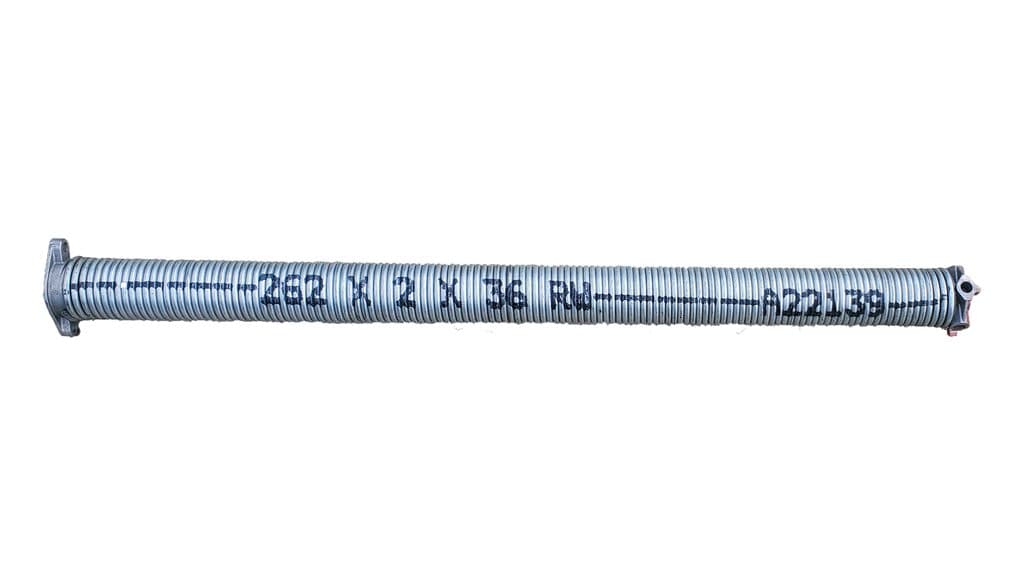
- Mounted on a steel shaft directly above the door opening, on the wall above the header
- One spring on many single doors, often two on wider or heavier doors
- The spring twists (winds) as the door closes and unwinds to help lift it
- Cable drums at each end of the shaft wind up the lift cables that attach to the bottom corners of the door
Extension springs
- Run parallel to the horizontal tracks, one on each side, above the door when it is open
- Stretch as the door closes and contract to help lift it
- Work with pulleys and cables
- Should each have a safety cable running through the middle of the spring. DASMA's safety tips say a door with extension springs needs a safety cable that runs through the spring and is secured to the wall or ceiling at each end, so a broken spring cannot whip across the garage.
If you are not sure which you have, look above the top of the closed door from inside the garage. A coil on a bar across the top is a torsion system. Long springs running front to back along the ceiling tracks are extension springs.
How to recognize a broken spring
Spring failures often happen with the door closed, because that is when the spring is under the most tension. Common signs:
- A loud bang from the garage, sometimes described as a gunshot or a dropped piece of metal, when nobody was using the door
- A visible gap in a torsion spring, usually a couple of inches where the coil has separated
- A stretched out or hanging extension spring, or a spring lying loose on its safety cable
- The opener hums, strains or stops after lifting the door a few inches, then reverses
- The door is extremely heavy when lifted by hand, or slams down instead of staying put
- The door rises crooked or one lift cable hangs slack
- The top panel bends as the opener tries to pull a door the springs are no longer supporting
If the door will not open at all, our garage door won't open guide walks through the other possible causes. If your car is stuck inside, read emergency garage door repair first.
Our guide on how to open a garage door manually explains when using the release is and is not safe.
Cycle ratings: why springs wear out
Springs fail from metal fatigue. Each time the door opens and closes (one "cycle"), the spring flexes, and eventually it cracks. How many cycles a spring lasts depends on how it was made and sized.
HomeAdvisor's 2025 spring cost guide puts typical torsion spring life at 10,000 to 20,000 cycles and extension springs at 8,000 to 15,000 cycles. How quickly you reach that depends on how often the door is used. A household that uses the garage as its main entrance, several times a day, wears springs out much faster than one that only opens the door occasionally.
Some springs are sold as "high cycle," using heavier wire or longer springs designed for more cycles. Whether that is worth paying for depends on how heavily you use the door; ask the technician what cycle rating they are quoting.
DASMA's technical data sheet on factors affecting spring cycle life lists several things that shorten spring life:
- The wrong spring for the door. A spring that does not match the door's counterbalance requirement can shorten the life of the door system and the opener.
- Too many or too few turns on a torsion spring. Too few can leave the door drifting down from the open position.
- Extra weight added to the door, for example from paint or things attached to it.
- Rust. DASMA notes that rust reduces the strength of spring wire and can start fatigue cracks.
- Lack of lubrication where the door manufacturer calls for it.
Why springs are usually replaced in pairs
If your door has two springs and only one has broken, a technician will usually recommend replacing both. DASMA's safety tips say plainly: "If your door has two springs, replace both, even if one is not broken." The reasoning is simple: both springs have done the same number of cycles, so the surviving one is likely close to the end of its life too, and a new spring paired with a worn one can leave the door out of balance.
This is also where pricing gets confusing. Some quotes are per spring and some are for the pair. When you compare quotes, ask each company for the total for the job you actually need.
Why this is not a DIY job
Torsion springs hold a great deal of energy. Winding or unwinding one uses steel winding bars, and a slip can release that energy instantly into your hands, arms or face. DASMA's article on torsion spring safety points out that these risks are documented by manufacturers, dealers, the Consumer Product Safety Commission and the National Safety Council, and advises consulting a trained door systems technician. Extension springs are dangerous too, particularly on older doors without safety cables.
There is also a sizing problem. Springs are matched to the door's weight, height and drum size. Guessing wrong leaves a door that is too heavy or too light, which strains the opener and can make the door unsafe to operate by hand. Our guide on why not to DIY garage door springs goes into more detail.
What a spring repair visit usually includes
A thorough technician will typically:
- Confirm which spring or springs have failed and identify the spring system
- Measure the existing springs or weigh the door to size the replacements
- Inspect the cables, drums, bearings, center bracket and bottom brackets for wear or damage caused by the failure
- Replace the spring or springs and set the tension to balance the door
- Check the balance by hand: a balanced door should stay roughly in place when lifted part way
- Test the opener's force settings and the auto reverse, and check that the safety sensors work
Frayed cables or worn rollers are common findings at the same visit. See garage door cable and roller repair.
What to ask a technician
- Is your quote for one spring or both, and does it include labor, parts and the trip charge?
- What cycle rating are the replacement springs, and what warranty comes with them?
- How did you size the springs: by measuring the old ones or weighing the door?
- Do my cables, drums or rollers need replacing now, and what happens if I wait?
- What is the name of your business, and does it match the name on the invoice?
Cost factors
HomeAdvisor's 2025 cost guide puts the national average for spring repair at about $250, with most homeowners spending $150 to $350. That is a national figure, not a local quote. The main things that move the price are the spring type, whether one or two springs are replaced, the size and weight of the door, the cycle rating, and whether cables or other parts need replacing at the same time. Our spring replacement cost guide breaks this down further.
Frequently asked questions
Can I open my garage door with a broken spring?
It is not a good idea. Without the spring, the door can be much heavier than it looks and can drop suddenly, and the opener can be damaged trying to lift it. If a car is trapped inside, a technician can usually secure and open the door safely. See how to open a garage door manually for when using the release is and is not safe.
Should both garage door springs be replaced if only one broke?
Usually, yes. DASMA's safety tips recommend replacing both springs even if only one is broken, because both have done the same number of cycles and matched springs keep the door balanced.
How long do garage door springs last?
It depends on the spring's cycle rating and how often the door is used. HomeAdvisor's 2025 guide puts typical torsion springs at 10,000 to 20,000 cycles and extension springs at 8,000 to 15,000 cycles. A door opened several times a day reaches those numbers much sooner.
Why did my spring break when nobody was using the door?
Springs usually break from metal fatigue after thousands of cycles, and a torsion spring is under the most tension when the door is closed. Rust, the wrong spring size or incorrect winding can make a spring fail earlier, according to DASMA's spring cycle life data sheet.
Does a garage door technician need a license in Texas?
Texas has no state license for garage door repair; it is not one of the trades regulated by TDLR. A license from the Texas DPS Private Security Program can apply when an opener is connected to an alarm system or access logging, as the DPS explains. For ordinary spring repair, check the company's reviews, real address and insurance instead.