
Short answer
North Texas sun can bow dark insulated doors and blind the opener's safety sensors, so choose lighter colors on doors facing the afternoon sun and shade the sensors if needed. After hail, photograph the door, file an insurance claim promptly, and be wary of door-to-door contractors. For wind, a new door should carry a wind-load label meeting your city's code; Plano, for example, lists a 105 mph design wind speed. During a tornado warning, go to an interior room on the lowest floor: a garage is not a shelter.
Summer sun and heat
Dark doors that face the sun
Insulated steel doors are built like a sandwich: two skins bonded to a foam core. When the outside skin gets much hotter than the inside, it expands more and the door bows outward. The door industry association DASMA explains this in Technical Data Sheet 185 on thermal bowing and says it is "an inherent characteristic" of these doors, not a defect. DASMA lists what makes it worse:
- Darker colors. A brown insulated door facing the sun on a hot day bows more than an equivalent white one.
- Sun exposure. A door in direct sun is more likely to bow than one out of direct sunlight.
- Size. Wider doors bow more; DASMA says an unreinforced 20 foot door can bow several inches.
- An air-conditioned garage, which widens the temperature difference.
Symptoms include the top section rubbing the header or a gap opening at the top. DASMA says the usual fix is reinforcement such as horizontal struts across the back of the door, following the manufacturer's recommendation.
Sun in the safety sensors
Low sun can shine directly into the photo-eye sensor near the floor and stop the door from closing. Genie explains in its sunlight interference guide that sunlight carries infrared light, the same as the sensor beam, and can overwhelm it. Fixes include swapping the sensors so the receiving unit is on the shaded side, moving it back from the opening while keeping it no more than six inches off the floor, or shading the lens. If the door only refuses to close at certain times of day, sunlight is a likely cause. See garage door sensor repair.
A hot garage
An uninsulated steel door in full Texas sun heats up, and so does the garage behind it. If the garage is attached or has a room above it, the wall and ceiling between the garage and the house matter as much as the door. See garage door insulation and R-value for how to compare doors without relying on inflated numbers.
Hail
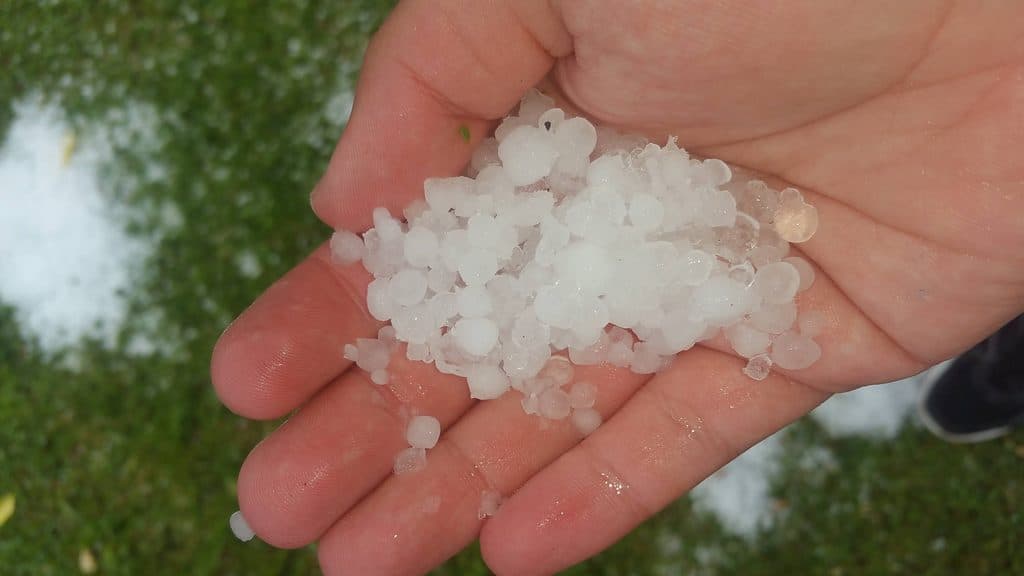
Collin County sees serious hail. The National Weather Service Fort Worth office's write-up of the April 11, 2016 storm says the supercell reached its maximum intensity as it moved into Collin County, affected 80% of homes in Wylie, caused over $300 million in damage, and set a record for the office's forecast area with a 5.25 inch hailstone.
What hail does to a garage door
Steel doors dent; windows in the top section can crack; wood and composite doors can split or chip. Cosmetic dents don't always stop a door working, but damage to the sections, track or hinges can. DASMA's Technical Data Sheet 174 gives homeowners a safe way to check a door after a storm:
- Start inside, door closed, with a flashlight.
- Look for misaligned sections, cracked glass, loose or bent track, rollers binding in the track, loose hinges and loose cables.
- Look at the sections from inside and outside for cracks, dents or buckling.
- Don't touch the springs or anything fastened to them.
- If you saw a problem, stop and call a trained door technician. If not, disconnect the opener with the door closed and lift it slowly by hand; if it's heavy, binds or won't stay open, lower it carefully and stop.
For how to decide between replacing dented sections and the whole door, see garage door panel replacement and repair or replace your garage door.
Filing an insurance claim
The Texas Department of Insurance's tips after hail or windstorms say to:
- File a claim as soon as you can.
- Take pictures and video of the damage, and make a list.
- Be there when the adjuster visits so they see everything.
- Get more than one repair bid and compare it with the adjuster's report.
- Never pay the full amount up front, and don't sign a contract with blank spaces.
TDI also points out that it's illegal under Texas law to waive a homeowners deductible, and that your insurer may ask for proof you paid it. A contractor who offers to "cover" or "eat" your deductible is offering something unlawful.
Storm chasers
After big storms, out-of-town crews knock on doors. After the October 2019 tornadoes in Dallas-Fort Worth, the Texas Attorney General issued tips to avoid contractor fraud: be cautious of contractors who solicit door-to-door, especially unfamiliar or out-of-town ones who pressure you to sign on the spot; don't sign your insurance check over to a contractor; get more than one estimate; never pay in full up front or pay cash up front; and get everything, including warranty terms, in writing. See garage door repair scams for how to check that a company is real and local.
Wind
Why the garage door matters in high wind
The garage door is usually the largest opening in a house. DASMA's Technical Data Sheet 192 explains that when a garage door opening is breached in a storm, wind pressure builds inside the garage and can lead to roof damage or worse. That's why building codes set wind load requirements for garage doors.
Wind-rated doors and the local code
Under the International Residential Code, garage doors must be tested for wind load and carry a permanent manufacturer's label showing the positive and negative design wind pressure rating, as DASMA summarizes in Technical Data Sheet 1502. Each city adopts its own edition of the code with local amendments. For example, Plano's 2024 International Residential Code amendments, posted on its building codes page, list a design wind speed of 105 mph (3-second gust) with Exposure C. Other Collin County cities adopt their own versions, so check with the city building department or look at the service area pages.
Two points DASMA makes in its wind FAQ (TDS 168) are useful when shopping:
- Doors are rated in pressure (psf), not miles per hour. The required pressure depends on the door size, the house height, exposure and other factors, so "rated for 130 mph" on its own doesn't tell you much.
- The building department is the final authority on what your door needs. You can look up the design wind speed for an address with the ASCE Hazard Tool, but the city's adopted code decides.
When replacing a door, ask the technician for the model's wind load label or rating and confirm it meets the city's requirement. See garage door installation.
Before and during a windstorm
DASMA's Technical Data Sheet 152 recommends:
- Close and secure the door before high wind arrives. An open door leaves walls, ceilings and the roof vulnerable.
- Don't operate the door during high wind; the extra force can injure you or damage the door.
- Don't park a car against the door as bracing; it doesn't reinforce the door and can damage both.
- Don't add bracing or weight yourself. Reinforcement kits need matching springs and hardware, fitted by a trained technician.
DASMA also notes in TDS 1503 that garage doors are not watertight, and strong wind can drive rain through the sides, bottom and section joints. Some water after a storm doesn't mean the door is broken; if it's a lot, the weatherseal may need attention. See garage door weatherseal replacement.
Tornadoes: the garage is not a shelter
DASMA's Technical Data Sheet 191 is blunt: "A garage, whether attached or detached, is not to be considered a tornado shelter." It also says no garage door is "tornado-proof"; "tornado-resistant" is the more accurate term.
For where to go, Ready.gov's tornado guidance recommends a safe room built to FEMA criteria or a storm shelter built to ICC 500, or otherwise a small, interior, windowless room or basement on the lowest level of a sturdy building.
After any storm: quick checklist
- Photograph the door inside and out before anything is moved.
- Do DASMA's visual check from inside with the door closed.
- Don't run the opener if the door looks crooked, a cable is loose or a spring is broken.
- File the insurance claim promptly if there's damage.
- Get a written, itemized quote from a local garage door technician, and compare it with the adjuster's report.
Frequently asked questions
Does homeowners insurance cover a hail-damaged garage door?
It depends on your policy and deductible, so ask your insurer. The Texas Department of Insurance says to file a claim as soon as you can, photograph and video the damage, be present for the adjuster, and get more than one repair bid. It's illegal in Texas for a contractor to waive your deductible.
What wind rating does a garage door need in Collin County?
It's set by your city's adopted building code. Plano's 2024 residential code amendments list a design wind speed of 105 mph (3-second gust), Exposure C. Doors are rated in pressure rather than mph, and the required rating depends on door size and the house, so the technician should confirm the door's wind load label meets the city's requirement.
Is a garage a safe place during a tornado?
No. DASMA says a garage, attached or detached, is not a tornado shelter. Go to a safe room or storm shelter, or a small interior windowless room on the lowest floor, as Ready.gov recommends.
Why does my garage door bow outward in summer?
It's likely thermal bowing: the sun heats the outer skin of an insulated door more than the inner one. DASMA says it's worse with dark colors, wide doors, direct sun and air-conditioned garages, and is usually reduced with struts across the back of the door as the manufacturer recommends.
Why won't my garage door close in the afternoon?
Low sun shining into the photo-eye sensor is a common cause. Genie says sunlight's infrared light can overwhelm the sensor beam. Shading the receiving sensor or moving it out of direct sun, while keeping it no more than six inches off the floor, usually solves it.