
Short answer
Many opener problems are simple: a remote battery, the lock feature, blocked safety sensors or a door that was disconnected with the release cord. If the opener hums but the door will not move, stop pressing the button and check for a broken spring before anything else. Worn drive gears, failed logic boards and bad travel or force settings are common repairs, while an opener with no working safety reversal should be replaced.
Is it the opener or the door?
An opener only has to guide a door that the springs are already holding up. When a door is balanced, it moves easily by hand and stays put when you let go partway. If the springs, cables or rollers are failing, the opener is working against dead weight, and it may strain, stall, hum or reverse. Replacing the opener will not fix that.
Chamberlain's guide to a door that won't fully open or close suggests disconnecting the opener and lifting the door by hand: if it feels heavy, sticks or drops, the door is out of balance and the problem is not the opener. Only do that check with the door closed, and skip it entirely if you can see a gap in a spring above the door.
Common opener symptoms and what they usually mean
The wall button works but the remote or keypad does not
This points to the remote, the keypad or the radio side of the opener rather than the motor. Chamberlain's remote troubleshooting steps are a good checklist for most brands:
- Replace the remote battery and check the contacts for corrosion.
- Check whether the lock (vacation) feature on the wall control is on. When it is, the opener ignores remotes.
- Test from directly under the opener. If a remote only works up close, Chamberlain says radio interference may be cutting its range.
- If someone held the LEARN button too long, the opener's memory may have been cleared and every remote and keypad will need to be programmed again.
- A remote that never worked may simply not be compatible with the opener.
The door starts closing, then goes back up
This is usually the safety sensors, not the motor. On many Chamberlain and LiftMaster openers, the lights flash when the sensors are blocked or misaligned. See garage door sensor repair for what to check.
If the sensors are fine, the cause may be the travel or force settings, or the door binding somewhere in its tracks. Chamberlain's diagnostic code guide lists separate codes for sensor faults, resistance while closing and the motor losing speed, so a flashing code on the opener's arrow lights is worth counting and writing down before you call anyone.
The opener hums or clicks but the door does not move
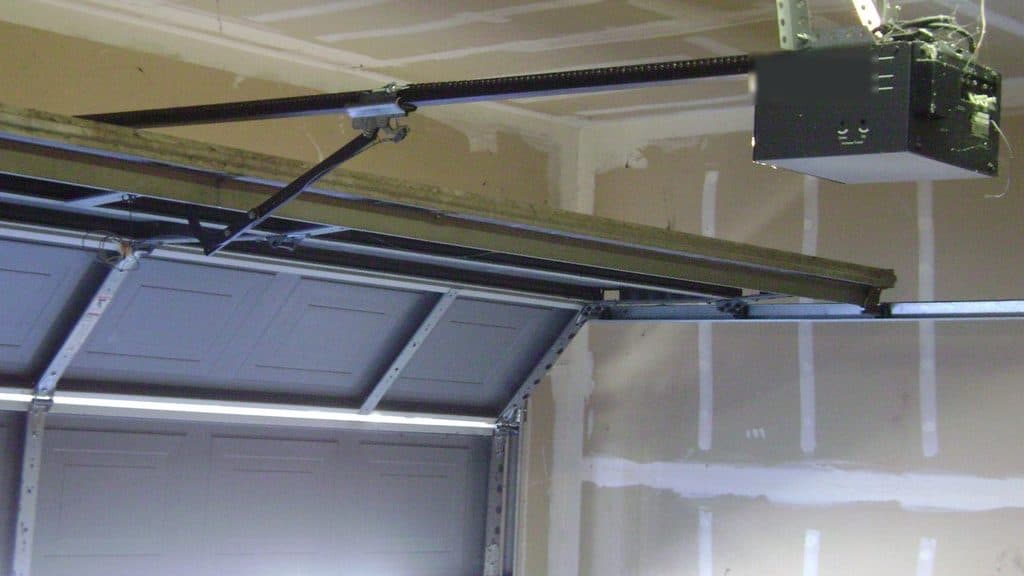
Stop pressing the button. Chamberlain's page on an opener that hums but the door does not move lists broken springs first, followed by the door lock being engaged, the trolley stuck, or the door disconnected from the opener. On some openers it can also be a failed capacitor, a failed logic board or stripped drive parts.
The motor runs but the door does not move
The trolley may be disengaged (someone pulled the release cord), or a gear inside the opener may be worn out. Manufacturers sell gear and sprocket kits for many chain and belt models because the drive gear is a known wear part. On an otherwise sound opener, this can be a reasonable repair.
Nothing happens at all
Check the outlet with a lamp, check the breaker, and check that the wall control is lit. If the opener has power but does not respond to anything, the logic board or the wall control wiring may be at fault. Replacement logic boards exist for many models, but on an older opener the price of a board plus labor can approach the cost of a new unit, so ask for both prices.
The door stops short or slams into the floor
Openers store travel limits (how far to go) and force settings (how hard to push before deciding something is in the way). If the limits drift or someone adjusts them, the door may stop short, leave a gap, or hit the floor and reverse. Chamberlain's travel and force adjustment hub stresses that the safety reversal test must be done after any adjustment. Turning up the force to push past a sticking door hides a real problem and makes the door more dangerous.
The federal safety rules for openers
Residential openers sold in the US must meet the federal standard at 16 CFR Part 1211, which follows the UL 325 standard the industry uses. Under section 1211.6, an opener must have built-in reversing protection plus a secondary means of protection, which on most homes is a pair of photo-eye sensors. Under section 1211.8, the opener has to check the secondary device during each close cycle, and if it is missing or faulty the door will not close normally. That is why a disconnected sensor stops the door from closing with the remote.
The required owner instructions in section 1211.16 also tell owners to test the opener monthly: the door must reverse on contact with a 1 1/2 inch object, or a 2x4 laid flat, on the floor. The same section says the wall button should be at least 5 feet above the floor so small children cannot reach it, and that remotes should be kept away from children.
The CPSC safety sheet on non-reversing openers notes that reversing systems have been required on openers made or imported for US sale since January 1, 1991, and external entrapment protection such as photo eyes since 1993. It urges homeowners to replace openers that do not reverse.
Repair or replace the opener?
A repair usually makes sense when the opener has working safety sensors and reversal, the part that failed is a known wear part (gear kit, sensor, remote, wall control), and parts are still sold for the model.
Replacement is worth considering when:
- The opener has no photo eyes or does not reverse. There is no sensible repair for an opener built before the federal rules.
- The logic board has failed on an older unit and a new board costs a large share of a new opener.
- Parts for the model are no longer made.
- You want features your current unit lacks, such as a quieter belt drive, a wall-mount (jackshaft) opener that frees up ceiling space, battery backup, or app control.
Our opener types guide compares chain, belt, screw and wall-mount drives in more detail.
Smart openers and alarm systems
Plain opener installation does not need a Texas Department of Public Safety license. The DPS Private Security Program says, however, that installing an opener that is connected to an alarm system, or that allows monitoring or logging of who comes and goes, does require a license. If you want the opener tied into an alarm or access control system, ask the installer about that licensing.
What to ask a technician
- Is the door balanced, and did you check the springs and cables before looking at the opener?
- Which part has failed, and can you show me?
- What does the repair cost compared with a new opener, installed?
- Are parts still available for this model?
- Will you run the reversal test with a 2x4 and check the sensors before you leave?
- Is the old opener included in the removal, and what warranty comes with the parts and labor?
For more on vetting a company, see choosing a technician. If the door itself is the problem, you may need spring repair rather than opener work.
Frequently asked questions
Why does my garage door opener hum but the door won't move?
A broken spring is the first thing to rule out, according to Chamberlain's troubleshooting page. Other causes include the door lock being engaged, a stuck trolley or a disconnected door. Stop pressing the button and look at the spring above the door before trying again.
Can I just turn up the force setting so the door closes?
Not as a fix for a door that sticks or binds. The force setting is part of how the opener decides it has hit something. After any force or travel adjustment, the door must reverse on a 2x4 laid flat, as the federal instructions in 16 CFR 1211.16 require owners to be told.
My remote stopped working but the wall button works. What should I check?
Replace the remote battery, make sure the lock or vacation feature is off, and test from under the opener. If the opener's memory was cleared, the remotes need programming again. See Chamberlain's remote checklist.
Do I need a battery backup opener in Texas?
The battery backup law often mentioned online, SB 969, is a California law. For a Collin County home it is a choice, not something that law requires. It can be handy during power outages; otherwise you can open the door by hand as described in how to open a garage door manually.
How often should I test my opener's safety reverse?
Monthly. The federal owner instructions and DASMA both call for a monthly test with a 1 1/2 inch object or a 2x4 laid flat on the floor.